
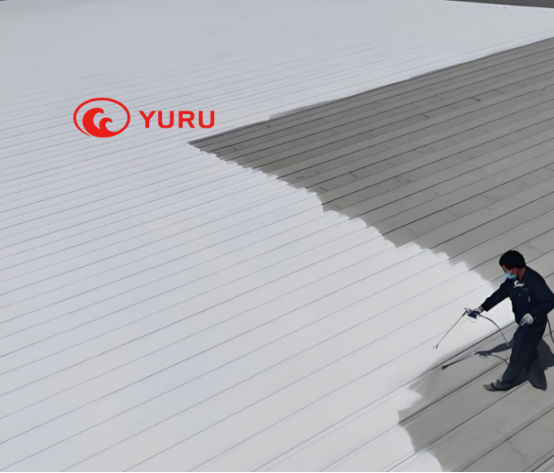
Liquid roof waterproofing can be used for full-area waterproofing or localized repair and is suitable for metal roofs, concrete roofs, basements, kitchens and bathrooms, large-scale infrastructure projects etc. There are three control points for success: ① substrate preparation; ② reinforcement of details – lap seams, gutters, fasteners, edge flashing; ③ ensure the coating reaches the required thickness and is fully cured. A major qualification: the number of coats, the application window, the temperatures and the humidity and the amount of coverage, all vary significantly between products and the individual product datasheet must take precedence. The conclusion: Roof coating failures are not a problem with the coating itself, but rather with the application of the paint and the selection of a suitable system.
What "Liquid Roof Waterproofing" Actually Covers
Liquid is an application format, not a material. At least seven liquid systems are commonly used on roofs, and their performance orientations differ completely.
|
System |
Carrier / curing method |
Typical roof use |
Main advantage |
Main limitation |
|
Acrylic |
Water-based, film formation by water evaporation |
Metal roofs, concrete roofs, exposed renovation |
UV-resistant when exposed, good adhesion, cold-applied, breathable |
Not resistant to long-term ponding (water-based systems can re-emulsify) |
|
Polyurethane (1K / 2K) |
Reactive curing (moisture cure / A-B component) |
Roofs requiring high mechanical strength and abrasion resistance, walkable roofs |
Good strength and impact resistance |
Sensitive to substrate moisture and application conditions |
|
Polyurea |
Two-component rapid reaction |
Industrial roofs requiring fast return to service and high abrasion resistance |
Extremely fast cure, high elongation |
Requires specialized two-component spray equipment |
|
Silicone |
100% solids or high solids content, no volatile carriers |
Commercial low-slope roofs, roofs with long-term water accumulation |
Best ponding resistance, longest reflectivity retention |
Low surface energy, poor compatibility with other systems (limits future recoating); prone to dirt accumulation |
|
Liquid rubber / butyl |
Solvent-based or water-based, film formation by evaporation |
Metal roofs, details and flashings |
High elasticity, good detail coverage |
Solvent-based types have VOC and odor issues |
|
Cementitious / polymer-modified (JS) |
Cement hydration + polymer film formation |
Concrete roofs, areas requiring rigid or semi-rigid protection |
Compatible with concrete, resistant to water pressure |
Low flexibility, does not accommodate large movement |
The methodology following the table is as follows: "Liquid" only governs how the product is applied, not how high the performance ceiling can be; it is the chemical system that determines the performance ceiling.
Choose the System First: Four Questions
What is the substrate? The range of available systems depends on the type of the roofing membrane to be replaced: Metal panel / Concrete / Wood / Existing membrane.
Do you need to keep it in the sun all the time? If the answer is yes, then you can eliminate systems that are not UV-resistant.
Are there any long-term ponding issues? If so, remove water-based acrylic and consider ponding-resistant systems.
What are the abilities of the application team? Brush and roller / airless spray / two-component hot spray equipment: spray polyurea can only be applied if the crew has the equipment.
For each question, reach a conclusion and determine the next step (request the datasheet for the appropriate system).
Which Roof Types Can Take Liquid Waterproofing?
|
Roof / substrate |
Optional liquid systems |
Constraints |
|
Color coated plate / aluminum plate / galvanized sheet |
Acrylic, liquid rubber, polyurethane |
Requires rust and oil removal; metal panels have large thermal movement and require sufficient elongation |
|
Aluminum composite panels |
Acrylic, liquid rubber |
Panel seams are the main weak point |
|
Concrete roof |
Acrylic, polyurethane, polyurea |
Concrete requires adequate curing; cementitious systems have low flexibility |
|
Wood substrate |
Acrylic (water-based systems better suited to porous substrates) |
Note the substrate moisture condition |
|
FRP lighting panel / Caprone board |
Acrylic, liquid rubber |
Seams and aged areas |
|
Existing membranes (PVC / asphalt / SBS-APP / EPDM / TPO) |
Select by compatibility; usually acrylic or dedicated recoat systems |
Must test-coat a small area first — incompatible system overlays are the most common cause of failure |
|
Toughened glass / curtain wall nodes |
Acrylic, transparent types |
Waterproofing focus on details |
Why Roofs Leak at the Same Five Details
|
# |
Leak point |
Why it fails |
General treatment approach |
|
1 |
Panel-to-panel lap seams |
Thermal expansion and contraction movement, sealant aging |
Detail reinforcement (fabric / reinforcement layer) + multiple coats |
|
2 |
Gutters |
Long-term water retention, debris scour |
Reinforcement + targeted thickening + ensure drainage slope |
|
3 |
Fasteners and nails |
Stress concentration, washer aging |
Point-specific reinforcement |
|
4 |
Ridge caps and edge flashing |
Maximum structural displacement |
Full coating + reinforcement layer |
|
5 |
Penetrations (pipes / fans / supports) |
Dissimilar material interface |
Flashing treatment + reinforcement layer |
The 7-Stage Application Workflow
Stage 1 — Don't coat until you've identified the cause. What to do: Identify weather the leak is of the "coating aging" type or the "structural / drainage" type. Acceptance: Leak path and root cause can be clearly identified. If it is a structural problem, then no coating will work.
Stage 2 — Choose the System. What to do: Use the four questions in the previous section to figure out the system. Acceptance: the system is compatible with the substrate, exposure conditions and crew capabilities.
Stage 3 — Set up the substrate. Proper procedure: remove floating rust, oil, and old loose coat, and test the compatibility of the new coating with the old one. Acceptance: No standing water, no floating rust, no loose material and the test coat sticks well. Usually cementitious systems need a moist substrate (not dry and absorbent) while solvent-based and reactive systems need a dry substrate.
Stage 4 — Prime if necessary. Action: Prime / seal according to according to product instructions. Acceptance: Primer coverage is uniform, with no missed areas, and the surface is dry. A primer may or may not be needed and the type of primer for the system and substrate type is dependent on the product system and substrate type (e.g., silicone on asphalt substrates usually requires a specific transition primer).
Stage 5 — Reinforce the details. Action: reinforce the five areas most prone to leakage. Acceptance: Reinforcement layer is continuous, with no voids or bubbles. Depending on the system used: film-forming materials (acrylic / polyurethane / asphalt-based) typically employ fabric reinforcement, polyurea systems are typically non-fabric because form a sufficiently thick film and cure quickly, and cementitious systems typically use alkali-resistant mesh for reinforcement.
Stage 6 — Build to target dry film thickness. The application technique: multiple coating to the designed film thickness. Acceptance: the measured dry film thickness meets the specification, not simply judged by "it looks like enough was applied". If the wet film thickness is too thick, or the next coat is applied too quickly, the coating may blister or cure incompletely (particularly with water-based acrylics).
Stage 7 — Cure, inspect, verify. What to do: cure to fully cured, then inspect for appearance and thickness. No bubbles, no voids, no misses areas = Acceptance.
Where Each Chemistry Diverges: A Stage-by-Stage Matrix
|
Stage |
Acrylic |
Polyurethane |
Polyurea |
Silicone |
Liquid rubber |
Cementitious / JS |
|
Substrate moisture |
Dry |
System-dependent |
System-dependent |
Dry |
System-dependent |
Often requires moist |
|
Primer |
Substrate-dependent |
Often required |
Often required |
Often required (transition primer on asphalt substrates) |
Substrate-dependent |
Product-dependent |
|
Reinforcement |
Fabric (details) |
Fabric (details) |
Generally not required |
Fabric (details) |
Fabric (details) |
Alkali-resistant mesh |
|
Coats |
Multiple |
Multiple |
Fewer, thicker coats |
Multiple |
Multiple |
2 coats common |
|
Recoat window |
After surface dry |
Per product |
Extremely short |
Per product |
Per product |
Per product |
|
Cure speed |
Medium |
Medium |
Extremely fast |
Medium |
Medium |
Slow |
|
Weather sensitivity |
High |
Medium |
Medium |
Medium |
Medium |
Medium |
Reinforcement: When Fabric Is Required and When It Isn't
Why details must be reinforced: at the points of displacement, a pure coating film cracks easily.
Usually, film-forming systems (acrylic / polyurethane / asphalt-based) require fabric reinforcement at lap seams, gutters, fasteners, edge flashing and penetrations. Most cementitious systems employ alkali-resistant meshes instead of fabrics. Please remember that the amount, type, and necessity of fabric depend on the product datasheet.
Weather Windows: One Universal Rule, Many Local Numbers
Hard rules for all: ① The substrate must be completely dry before surface application or the required time must have passed since the last application; ② Each coat must be applied only after the previous coat is surface dry or the specified recoat interval has elapsed; ③ There shall be no rain exposure or foot traffic before curing.
State explicitly: The windows for temperature and humidity are all different and should be verified with the product datasheet for each system considered: Polyurethane, polyurea, cementitious, and asphalt-based.
Common Failures: Causes and Prevention
|
Failure |
Cause |
|
Peeling, flaking |
Oil / floating rust / incompatible old coating on the substrate |
|
Blistering, bubbling |
Single coat too thick, recoating without observing the specified interval, substrate moisture too high |
|
Detail leak recurrence |
No reinforcement layer, or voids in the reinforcement layer |
|
Insufficient film thickness |
Insufficient quantity, insufficient coats |
Failures also occur as follows: water-based acrylic: long-term ponding causes re-emulsification and film degradation (the most typical failure mode of this system); reactive systems (PU /polyurea): incorrect ratio, uneven mixing, exceeding pot life; cement-based materials: insufficient curing, substrate too dry causing incomplete hydration.
FAQ
Can you apply liquid waterproofing on a metal roof? Yes.
Which liquid waterproofing is best for a roof? The answer depends on the conditions: exposed → UV-resistant system; ponding → ponding-resistant system; fast return to service required → polyurea.
Do I need reinforcement fabric? It depends on system and location; film-forming systems typically require it at details, while polyurea typically does not.
Can I apply liquid waterproofing over an existing roof coating? You must test-coat a small area first to confirm compatibility.
What temperature can liquid roof waterproofing be applied at? It varies by system; for example, acrylic waterproof coating at 5–35°C and RH<85%, but the specific product datasheet must be checked.
Conclusion
Two closing points: select the right system first, then discuss application quality. The three restated control points: substrate, detail reinforcement, and film thickness acceptance. Next step: determine substrate and exposure conditions → request the corresponding system datasheet → verify coverage rate and application window. YURU Engineering Materials manufactures acrylic, polyurethane, JS, and crystalline waterproofing systems, with ISO 9001, ISO 14001, and CE certification.
Table of Contents
- What "Liquid Roof Waterproofing" Actually Covers
- Choose the System First: Four Questions
- Which Roof Types Can Take Liquid Waterproofing?
- Why Roofs Leak at the Same Five Details
- The 7-Stage Application Workflow
- Where Each Chemistry Diverges: A Stage-by-Stage Matrix
- Reinforcement: When Fabric Is Required and When It Isn't
- Weather Windows: One Universal Rule, Many Local Numbers
- Common Failures: Causes and Prevention
- FAQ
- Conclusion
