
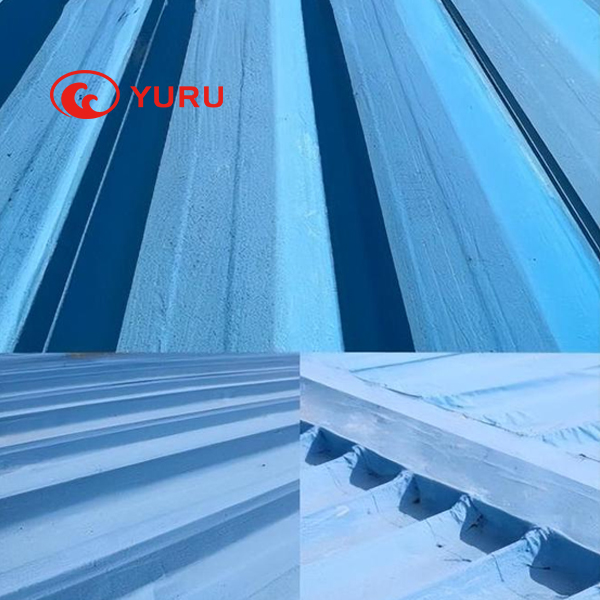
Acrylic waterproof coating can be applied on metal roof surfaces such as color-coated plates, aluminum plates, galvanized sheets, aluminum composite panels, covering the entire surface of the metal roof or as a local repair. The three points of success or failure are: ① substrate cleanliness and removal of rust; ② cover the overlaps with fiberglass cloth and apply fully saturated paint; ③ each coat must be dry before the next. There is one hard limit: ambient temperature must be in the range of 5-35°C and water must not be added when applying the material and the relative humidity must be lower than 85%. The conclusion: the vast majority of failures on metal roofs are issues of application, not material failures.
Why Metal Roofs Leak at the Same Five Places
|
# |
Leak point |
Why it fails |
Coating approach |
|
1 |
Lap joints between panels |
Thermal expansion causes movement; sealant ages and cracks |
Fiberglass cloth reinforcement + multiple coats |
|
2 |
Gutters |
Standing water, debris scour |
Reinforcement layer + extra thickness |
|
3 |
Fasteners and nails |
Stress concentration at screw heads; washer aging |
Point-specific reinforcement |
|
4 |
Ridge / edge flashing |
Maximum structural displacement |
Full coating + reinforcement layer |
|
5 |
Penetrations (pipes, fans, supports) |
Dissimilar material interface + movement |
Flashing treatment + reinforcement layer |
Almost all metal roof leaks occur at these 5 points—NOT on the surface of the roof panel. The application focus is not on coating anything, it is on reinforcing these 5 locations.
Substrates You Can Coat Directly
|
Substrate |
Compatible |
Prep note |
|
Color coated plate |
✅ |
Remove oil and loose coating |
|
Aluminum plate |
✅ |
Clean surface; remove oxidation and dust |
|
Galvanized sheet |
✅ |
Note passivation film; perform an adhesion test |
|
Aluminum composite plates |
✅ |
Panel seams are weak points |
|
Wood |
✅ |
Porous substrate; check moisture content |
|
Concrete / solid brick wall |
✅ |
Concrete requires adequate curing |
Before You Start: Surface Preparation Checklist
This is the most significant factor that determines the life of metal roof coatings.
Remove loose material: loose rust, flaking old paint and dust.
Degrease: Oil contamination will result in zero adhesion.
Old coating compatibility test: always test coat a small area first before full coating.
Dryness of substrate: check that surface is dry.
Environmental conditions: check 5-35°C, RH<85%.
Step-by-Step: How to Apply Acrylic Waterproof Coating on a Metal Roof
Step 1 – Uniformly mix coating before use.
Method: stir well after opening drum.
Pass criteria: no sediment / no separation.
Common mistake: adding water to dilute the solution.
Step 2 — Prepare and clean lap seam surface.
Method: first clean the seam surface, and then brush the coating on the seam surface.
Pass criteria: no floating dust, no loose material.
Common mistake: Applying coating on top of an uncleaned old seam.
Step 3: Lay fiberglass cloth and fully saturate.
Method: cover it with cloth and coat over it, until the cloth is completely covered.
Pass criteria: no bubbles, no voids.
Common mistake: proceeding to the next step before the cloth is fully saturated; this causes air pockets.
Step 4 — Apply 1 – 2 additional topcoats.
Method: 1-2 coats of finish applied over treated waterproofing.
Pass criteria: make sure the film is continuous and no areas are missed.
Step 5 — Observe full dry time between every coat.
Method: allow previous coat to dry before applying the next coat.
Pass criteria: tack-free to the touch.
Common error: recoating before dry to save time, which is the major cause of blistering and bubbling issues.
Step 6 — Protect the finished membrane.
Method: no walking around until film is completely dry.
Pass criteria: open to traffic when fully cured.
Application conditions summary:
Ambient temperature 5–35 °C.
Relative humidity < 85%.
Dilution: Water addition is not allowed.
Brushing: Mix thoroughly before brushing.
Storage and transport: Keep away from cold, frost and sunlight; store liquids at no less than 5 °C.
Where Glass Fiber Cloth Reinforcement Is Mandatory
Required areas: lap seams, gutters, around fasteners, ridge and edge flashing, penetrations and cracks.
The reinforcement layer can be used as a load-bearing skeleton, distributing stress and preventing the coating film from cracking at stress displacement points.
|
Condition |
Requirement |
Why |
|
Air temperature |
5–35°C |
Below 5 °C, the film cannot form properly; above 35 °C, it affects workability |
|
Relative humidity |
<85% |
High humidity blocks water evaporation; incomplete film formation |
|
Between coats |
Fully dry (tack-free to the touch) |
Recoating too early causes blistering and bubbling |
|
Rain |
— |
Confirm each coat's surface dry time against on-site temperature and humidity; avoid scheduling coats that cannot dry before a rain window |
Weather Window: Temperature, Humidity and Rain
How Many coats are required? (Calculation)
The quantity of coating required (kg) = Roof area (m²) x Target film thickness (mm) x 2.5 (kg/m² per mm).
Packaging conversion: If the total quantity of the product is 20 kg per iron drum → number of drums = total quantity ÷ 20, rounded up.
Notes:
This dosage is a reference for about 2.5 kg/m² per mm of film thickness.
Losses onsite (roughness of site, seams with reinforcement, thickening of gutters) will greatly exceed actual consumption.
Consumption of reinforcement layers and gutters needs to be calculated in a separate manner.
Common Metal Roof Application Mistakes That Cause Failure
|
Mistake |
Consequence |
Correct practice |
|
Adding water to dilute |
Reduced film density, compromised strength and waterproofing |
Never add water |
|
Recoating before dry |
Blistering, bubbling |
Wait until the coating is tack-free to the touch |
|
No glass fiber cloth at lap seams |
Cracking and leak recurrence at seams |
Set up mandatory reinforcement layers |
|
Cloth not saturated |
Cavities under cloth become water channels |
Coat to full saturation, no bubbles or voids |
|
Floating rust not removed |
Adhesion failure; rust continues to spread |
Thorough rust removal before application |
|
Applying at RH>85% |
Incomplete film formation |
Strictly observe the application window |
|
Applying below 5°C |
Film cracking |
Observe the lower temperature limit |
Inspection and Maintenance Schedule
Acceptance checks: appearance, coverage completeness, reinforcement locations, no bubbles or voids.
Recommended inspection frequency: at least once in the first year, then as appropriate to site conditions. Target the five high-incidence leak points.
Local repair procedure: clean the damaged area; if it is at a seam or penetration, add reinforcement; recoat to the thickness of the surrounding film.
FAQ
Can you apply acrylic waterproof coating to a metal roof?
Yes, it works with color-coated plates and aluminum plates, galvanized sheets, and aluminum composite panels.
Do I need to use glass fiber cloth on a metal roof?
Yes, at lap seams, gutters, fasteners, ridge/edge flashing, penetrations, and existing cracks.
Can I dilute acrylic waterproof coating with water?
No. The specification explicitly prohibits adding water.
How long between coats of acrylic roof coating?
Tack-free to the touch before applying the next coat; the previous coat has been completely dried.
How much acrylic coating do I need for a metal roof?
Area (m²) × target film thickness (mm) x 2.5 kg/m² per mm. Round up the drum count.
What temperature and humidity does acrylic roof coating need?
5-35 °C and relative humidity below 85%.
Conclusion
Success is controlled by three variables: substrate prep, reinforcement, and leaving the recommended full drying time between coats. The next step: ask for the technical datasheet, recheck your dosage calculation, and ensure you're within the application window.
YURU Engineering Materials—ISO 9001, ISO 14001, and CE approved,— acrylic waterproof coatings for metal roof restoration, including complete onsite construction services.
Table of Contents
- Why Metal Roofs Leak at the Same Five Places
- Substrates You Can Coat Directly
- Before You Start: Surface Preparation Checklist
- Step-by-Step: How to Apply Acrylic Waterproof Coating on a Metal Roof
- Where Glass Fiber Cloth Reinforcement Is Mandatory
- Weather Window: Temperature, Humidity and Rain
- Common Metal Roof Application Mistakes That Cause Failure
- Inspection and Maintenance Schedule
- FAQ
- Conclusion
