
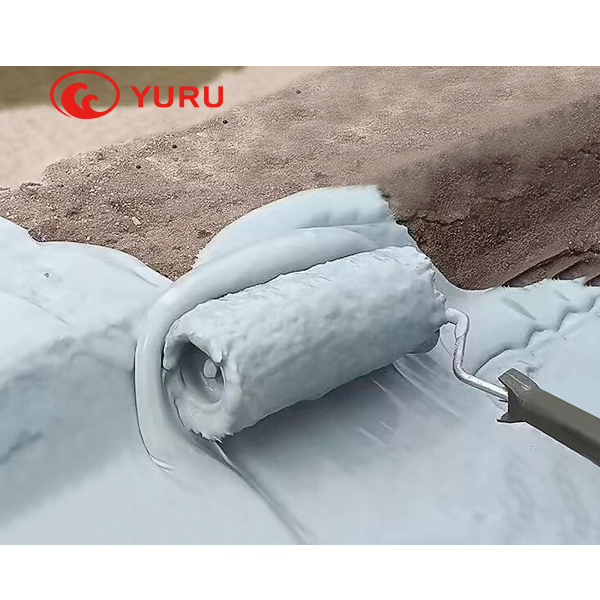
"Elastomeric" is not a marketing idea, it actually has a true definition—a coating film that will flex and bend with the substrate without cracking or peeling and will spring back when the substrate springs back. The only two indications required for judgment are: elongation at break, and low-temperature bending. For instance, a qualified acrylic elastomeric roof coating should have the following characteristics: untreated tensile strength ≥1.5 MPa and elongation at break ≥150%; crack-free after 1 hour at −30 °C.
What Actually Makes a Roof Coating "Elastomeric"?
Elastomer: a synthetic rubber-ike polymer with elastic properties above Tg (i.e., rubber). In latex systems, low temperature flexibility is achieved by low Tg of the polymer (20°C or below) and the use of coalescing agents and plasticizers which allow the film to remain soft and flexible.
Don't confuse "elastic" with strong. Some coatings boast high tensile strengths but low elongation. On metal roofs with daily temperature variations, a non-expansive coating film is going to crack. The key takeaway when choosing a coating: you want the film to move with the substrate, not against it.
Why Elongation at Break Matters More Than Tensile Strength
Metal roofs do not carry the load; they deform with temperature. Small cracks develop in concrete substrates, and the seams will not stay in place. The coating film must accommodate this movement without cracking.
All ASTM D6083 liquid-applied acrylic roof coatings specifications require a minimum 100% elongation at break in 14 days after full cure. The better formulas are far beyond this—and commercial formulations go to 301% elongation with 1.8 MPa tensile strength, more than enough to allow for movement without compromising other elements of the formulation.
How to Read a Roof Coating Datasheet: 5 Numbers That Predict Performance
|
Indicator |
Benchmark Value |
What It Actually Predicts |
How to Verify |
|
Non-treatment tensile strength |
≥ 1.5 MPa |
Resistance to mechanical damage and substrate cracking |
Request third-party test report; perform finger-press and scratch tests on sample |
|
Elongation at break |
≥ 150% |
Ability to follow thermal expansion/contraction without cracking — the most critical metric |
Cast a film, hand-stretch it, observe for brittle fracture |
|
Water impermeability |
0.3 MPa × 30 min, impervious |
Resistance to water pressure penetration |
Request water impermeability test report |
|
Low-temperature bending |
−30°C × 1 h, no crack |
Winter performance in cold climates — no embrittlement or cracking |
Freeze sample, bend it, inspect for cracks |
|
Dosage |
~2.5 kg/m² per mm film thickness |
Determines actual dry film thickness, which governs service life |
Calculate required volume by area; verify drum count on delivery |
Why Low-Temperature Bending Separates Real Elastomeric Coatings from Marketing Claims
The acid test is cold-flex. Authentic elastomeric acrylics should not crack after 1 hour exposure to −30°C.
Roofs are not warm surfaces and during winter, surface temperatures frequently fall below -20°C in the northern part of the country. At these temperatures, glassy and brittle film will lead to cracking of the film due to the natural transition of the material from thermal motion. ENCOR Flex 1361 products offer the flexibility at temperatures as low as 0°F (-18°C). Quality Architectural grade coatings such as Yuru acrylic waterproof coating will operate in temperatures of -30°C.
The Properties of Acrylics Under Intense Sunlight: UV Resistance and Reflectivity
Acrylic polymers are very resistant to UV degradation due to the fact that they contain a carbon-carbon backbone and do not contain UV-sensitive additives. Titanium dioxide (TiO₂) pigments are applied to provide opacity and some reflectivity to help reduce the surface temperature.
White acrylic elastomeric coatings offer two benefits; UV protection and cool roof. Dark roofs with no coating will have surface temperatures 10-15°C lower. Usually, the solar reflectance of acrylic coatings is greater than or equal to 0.90. As dirt accumulates due to aging, reflectance decreases, so the surface must be cleaned periodically to maintain performance.
There is one caveat, however—reflectivity is a property that depends on maintenance. Over time, reflectance decreases due to dirt, biological growth and chalking. Ambient-crosslinking acrylics and other formulations that show improved dirt-pickup resistance hold their reflectance longer over the course of the year.
Elastic Recovery Under Roof Movement: Joints, Panels and Thermal Cycling
The roof behaviors can be one of three major displacement scenarios:
Thermal expansion of metal panels — Metal panels, from standing seam to corrugated, will expand and contract by a quarter of an inch or more each day. The coating must be flexible.
Lap seam movement — stresses accumulate on the lap seams and overlapping panels. These loads are taken by a load-bearing structure comprising a fabric reinforcement of glass fibres that distributes the load over a larger area.
Concrete micro-cracking — superfine cracks that may open and close again in the presence of water, and shrink and expand according to the temperature on the surface. Flexible acrylics simply take the shock.
Reinforcement is not required in areas of low movement. Otherwise, the coating will become thin in seams and be ineffective soon.
Where Elastomeric Acrylics Still Underperform
Ponding water. Elastomeric coatings are not designed to prevent immersion issues; they are designed to prevent movement issues. Water-based acrylic films will break down under constant exposure to water. Silicone coatings or improved drainage are options for roofs that retain water for prolonged periods.
Application window restrictions. The parameters of 5-35°C and RH<85% are true restrictions. The coating is prone to poor film formation under low-temperature or high-humidity, which can cause early failure.
Several coats, dry time. Elastomeric systems often require multiple coats and are allowed to dry before applying the next coat. Therefore, it takes longer to complete the project than to apply a single coat.
4 Field Tests a Buyer Can Run Before Committing to a Supplier
1. Film formation test. Use a small sample and allow it to cure for 24-48 hours. Feel it — if it is tacky or soft, there may be inadequate coalescence or cure conditions.
2. Stretch-and-recover test. Cast a film strip, allow it to completely cure and stretch it by hand. Watch if it stretches out evenly or snaps. Let it go — does it bounce back or remain misshapen?
3. Cold-bend test. Put a cured film sample into a freezer for an entire night. Take it off and then immediately bend it around a small radius. Cracks are a sign of low-temperature flexibility.
4. Fiberglass saturation test. Apply a fiberglass mat to a sample surface, apply coating and test it once cured. There should be no dry spots, bubbles or delamination in the mat.
FAQ
What does elastomeric mean in a roof coating?
It refers to the cured film being rubber-like elasticity, which means it will stretch as the substrate stretches, and recover without cracking or delaminating. Elongation at break and low-temperature flexibility are important indicators, not just marketing terms.
What elongation should an acrylic roof coating have?
ASTM D6083 specifications call for 100% elongation at break. Some premium elastomeric products are over 300%, while most products, such as YURU acrylic roof coating, are over 150%.
Can acrylic elastomeric coatings be used in cold climates?
Yes, as long as they meet the relevant low-temperature bending requirements for the service temperature, with no cracking at −30 °C. Do always verify the cold-flex rating of your product.
Is elastomeric coating the same as waterproofing?
Elastomeric refers to mechanical properties. Waterproofing implies water Resistant. An elastomeric coating may not be necessarily provide resistance to ponding water. Elastomeric acrylics provide both properties for exposed roofs and roofs with sufficient drainage.
How do I test an acrylic roof coating before buying in bulk?
Take a sample, make a film, cure it properly and then perform the four above tests: film formation, stretch-recover, cold-bend, fiberglass saturation.
Conclusion
Test an acrylic elastomeric roof coating in two indicators: elongation at break (150%) and low-temperature bending (−30 °C, no crack). All other performance tests, including tensile strength, adhesion, and water penetration resistance, come down to those two indicators.
In moderate to cold climates, when the roof is exposed to the weather, has adequate drainage, and a tested elastomeric acrylic coating is applied at 5–35 °C and below 85% RH, you can have a proper restoration. If your roof is prone to ponding water or will be subject to immersion, there are alternatives.
Next step: Request technical datasheets and samples for field testing. Check the stated elongation and cold-flex values from the independent report.
YURU Engineering Materials has several acrylic elastomeric roof coatings for metal roof restoration that have been tested to confirm elongation and low-temperature flexibility. For technical data and samples, contact us.
Table of Contents
- What Actually Makes a Roof Coating "Elastomeric"?
- Why Elongation at Break Matters More Than Tensile Strength
- The Properties of Acrylics Under Intense Sunlight: UV Resistance and Reflectivity
- Elastic Recovery Under Roof Movement: Joints, Panels and Thermal Cycling
- Where Elastomeric Acrylics Still Underperform
- FAQ
- Conclusion
