
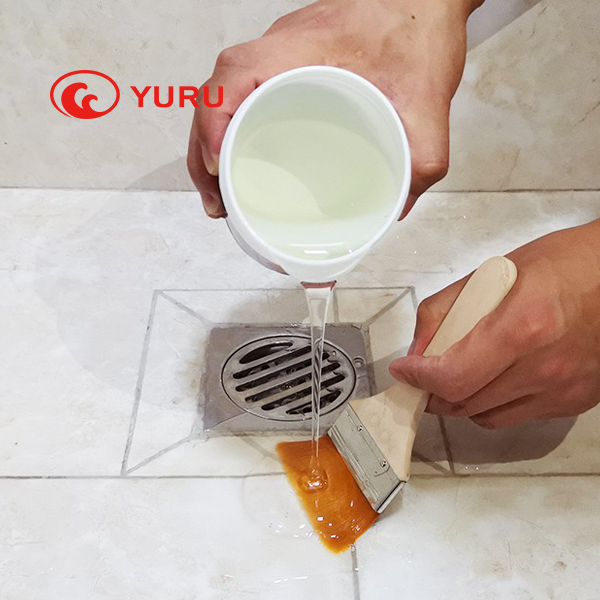
Liquid waterproofing is a system of waterproofing applied as a liquid, which sets in place on the substrate to create a seamless monolithic membrane. It features multiple chemistries: acrylic, polyurethane, liquid rubber, polymer cement (JS), crystalline, silicone, and polyurea, each of which has a different film-forming mechanism and performance envelope. It is not recommended for continuous submersion, for projects where temperature and humidity criteria in the application window cannot be met or for unprepared substrates. This article will give you the classification, failure boundary and indicator interpretation you will need to identify your correct system.
What "Liquid Waterproofing" Actually Means
Liquid waterproofing is defined by three elements: liquid application, in-situ film formation, and a seamless, fully bonded membrane. Applied as a liquid or paste by brush, roller, or spray, the coating cures on the substrate to provide a continuous waterproof seal.
The key thing that sets it apart from a fabricated sheet membrane is the location in which the membrane is made. The sheets of membrane are rolled and formed under controlled factory conditions, cut to size, and connected during installation through laps and seams. A liquid system takes film formation to the job site, where the substrate acts as the mold, and the final product is a membrane without laps, seams, or adhesive failure lines. What's traded is the quality, which now relies on conditions and applicator discipline on site rather than in the factory.
The Seven Liquid Systems: Which One Are You Actually Buying?
|
System |
Film-forming mechanism |
Typical applications |
Product page |
|
Acrylic |
Water evaporation → polymer particle aggregation |
Exposed roofs, metal substrates, wood substrates |
Acrylic waterproof coating product page |
|
Polyurethane (single/two-component) |
Reactive curing (moisture cure / A-B component reaction) |
Damp substrates, areas requiring high mechanical strength |
Polyurethane coating product page |
|
Liquid rubber / high-elastic emulsion |
Water evaporation film formation, high elongation |
Roofs, areas requiring high elasticity |
High-elastic waterproof coating product page |
|
Polymer cement / JS |
Cement hydration + polymer film-forming dual network |
Interior wet areas, concrete, negative-side waterproofing |
JS polymer product page |
|
Crystalline (CCCW) |
Penetrates concrete and crystallizes to block capillaries |
Concrete structures, negative-side waterproofing |
Cementitious product page |
|
Polyurea |
Rapid reaction curing |
Areas requiring fast return to service, high abrasion resistance |
Polyurea product page |
|
Silicone |
100% solids / high solids, no carrier evaporation |
Exposed roofs, UV resistance |
Silicone product page |
How Liquid Waterproofing Forms a Membrane
Evaporation-based systems (acrylic, liquid rubber) use the evaporation of water or solvent from the film. They require dryness and good air circulation. When the temperature is below the minimum film-forming temperature, the polymer particles do not coalesce effectively, and the film is weak or powdery.
Polyurethane and polyurea are examples of reaction-curing systems, which use chemical crosslinking. Moisture cured PU requires humidity to cure, but is sensitive to low temperature and standing water. It cures fast enough that it can be used in environments that other systems can't,but it does need special equipment.
Hydration and crystallization systems (JS, crystalline) require the presence of cement and water. JS requires water to help with the cement hydration process; crystalline materials require water as a medium to transport active chemicals within the concrete.
The seamless nature of liquid systems – the most frequent failure point of sheet membranes (seams) is avoided. However, it translates a factory controlled variable into a site controlled variable. If the membrane is to be seamless, then the preparation and application of the substrate are equally important.
Where Liquid Waterproofing Works — and Where It Doesn't
Liquid systems work well on complex geometries such as penetrations, drains, parapets, equipment curbs and irregular shapes for which it is difficult or impractical to cut and fit a sheet membrane. They can be applied to metal roofs, concrete decks, wood substrates, and existing membranes as long as compatibility is assured.
They are not suitable for permanent exposure to water. Acrylic and JS systems are intended to be exposed rather than permanently submerged. Where hydrostatic pressure is applied, such as below-grade structures and water tanks, polyurethane, polyurea, or crystalline systems are better suited to the application.
The Five Limits That Decide Whether It Works
|
# |
Limit |
Specific condition / basis |
Consequence |
|
1 |
Application temperature and humidity window |
Temperature 5–35°C |
Incomplete film formation, cracking |
|
2 |
Full drying time between coats |
Pass criteria: hand-touch tack-free |
Blistering and bubbling caused by recoating before drying |
|
3 |
No water dilution |
— |
Reduced film density, compromised strength and waterproofing |
|
4 |
Substrate preparation |
Floating rust, oil, loose old coating directly cause adhesion failure |
Peeling, delamination |
|
5 |
Long-term immersion |
Some waterproof coating systems are designed for exposed waterproofing, not long-term immersion; if required, choose silicone |
Failure in ponding areas |
The process for determining whether a liquid waterproofing product is "good" is straightforward: first, make sure the installation was compliant. Formulation failure is rarely the cause, as most failures are related to site conditions.
Liquid vs.Sheet: A Quick Orientation
Liquid systems excel in seamless coverage and complex details. They fit any shape, are free of lap failures and adhere to the substrate surface entirely. Sheet membranes take the prize for uniformity of thickness and quality control in the factory. The thickness of the membrane is determined prior to installation and the material is tested as manufactured. Sheet membranes may be quicker and more predictable for large, simple roof spaces. Liquid systems is often the best option when dealing with more complex geometries or repairs.
Choosing a System: A Decision Path
Question 1: What is the substrate—metal, concrete, wood or an existing membrane? This will decide which systems can be used together.
Question 2: Is it permanently exposed to UV? If yes, consider acrylic, silicone or UV-stable polyurethane/polyurea. If no, it means more options.
Question 3: Is there long-term ponding or high mechanical demand? If yes, consider polyurethane, polyurea, or crystalline rather than acrylic or JS.
Question 4: Can the application window meet dry conditions? If no, do not use evaporation-based systems; instead, use reaction-curing or moisture-tolerant systems.
Following each answer, ask for the corresponding product datasheet and compare the performance indicators with the service conditions.
FAQ
What is liquid waterproofing?
A liquid-applied coating that cures in place to form a seamless, fully bonded waterproof membrane.
Is liquid waterproofing as good as a membrane?
It depends on the application. Liquid wins on complex details and seamless coverage. Sheet wins on uniform thickness and factory quality control.
How long does liquid waterproofing last?
Service life is determined by film thickness, substrate preparation, application compliance, and exposure conditions — not by the product category alone.
Can liquid waterproofing be applied over existing coatings?
Only after confirming compatibility with a test patch. Some systems adhere well to certain existing membranes; others do not.
How many coats of liquid waterproofing do I need?
Typical systems: reinforcement at seams and penetrations, then 1–2 finish coats. Follow the specified dry film thickness.
Is liquid waterproofing suitable for showers?
Interior wet areas generally use JS or polyurethane systems, selected for compatibility with tile adhesives and substrate conditions.
Is liquid waterproofing the same as liquid rubber?
No. Liquid rubber is one category within liquid waterproofing, alongside acrylic, polyurethane, JS, crystalline, polyurea, and silicone.
Conclusion
Liquid waterproofing is a liquid-applied, in-situ-cured, seamless membrane system available in seven distinct chemistries. The choice depends on substrate, UV exposure, water contact, and application conditions. It fails when used outside its design envelope: constant immersion, poor substrate preparation, or non-compliant application. Next step: confirm your substrate and exposure conditions, then request the datasheet for the specific system that matches them.YURU Engineering Materials manufactures acrylic, polyurethane, JS, and crystalline waterproofing systems, with ISO 9001, ISO 14001, and CE certification.
Table of Contents
- What "Liquid Waterproofing" Actually Means
- The Seven Liquid Systems: Which One Are You Actually Buying?
- How Liquid Waterproofing Forms a Membrane
- Where Liquid Waterproofing Works — and Where It Doesn't
- The Five Limits That Decide Whether It Works
- Liquid vs.Sheet: A Quick Orientation
- Choosing a System: A Decision Path
- FAQ
- Conclusion
