
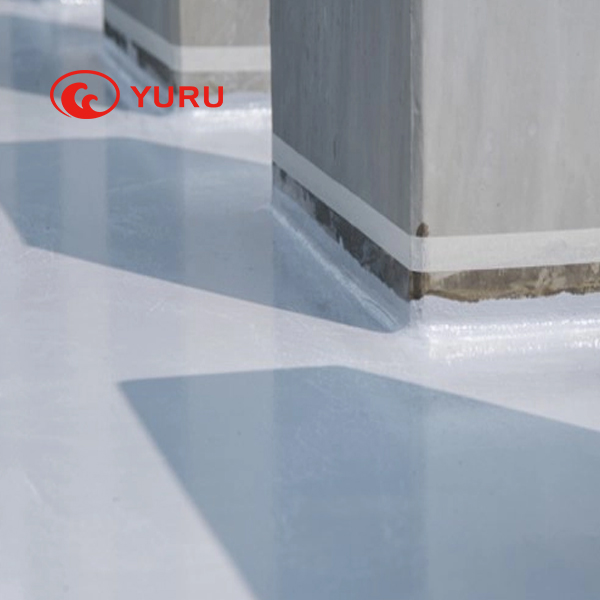
Acrylic waterproof coating: water-based paint, its film-forming material is acrylic ester polymer emulsion, forming a whole membrane with full adhesion. Only one coat is needed on the metal roofs and walls, concrete, solid brick, wooden substrates, existing waterproofing membranes (PVC, asphalt, SBS/APP, EPDM, TPO), FRP lighting panels, toughened glass and curtain wall joints. Do not apply to areas where water regularly accumulates the surface, projects that cannot sustain temperature of 5-35 °C and relative humidity below 85%, or substrates that are not completely dry. This article provides you with all the selection criteria, the indicator explanations, and the application checklist.
What Is an Acrylic Waterproof Coating?
The film forming process is as follows: water-based emulsion → evaporation of water → coalescence of polymer particles → continuous film. This is a single-component product, no mixing of A and B (two-component products are another story).
With the coating applied, the construction process is seamless, and the coating is 100% adhesive, so there is no need for overlaps or seams. With a membrane, each sheet must be overlapped and the seams must be sealed. Coatings eliminate the weak link of any waterproofing system—the seams—making them inconsequential, particularly in the case of complex roof geometries, including penetrations, drains, parapets and equipment curbs.
How Acrylic Waterproof Coatings Work: Film Formation, Breathability and Adhesion
There are three metrics of performance:
Film formation. The water evaporates, and acrylic polymer particles agglomerate and merge into a continuous film without any voids. Coalescence is influenced by temperature and occurs when the temperature is above minimum film-forming temperature (MFFT) —which is usually above 5 °C for standard formulations.
Breathability. The acrylic film is water-vapor-permeable. In roof restoration, this is highly relevant as moisture tends to be trapped in aged substrates. The vapor is encapsulated in a non-breathable coat, and the vapor expands when it heats up, resulting in blisters. The breathable acrylic film permits the vapor to escape, reducing the chance of blistering.
Adhesion. Acrylics bond with these substrates by a combination of mechanical locking and polar interaction. For metals, adhesion is based on surface preparation, i.e., the removal of oil, rust, and loose surface material. On the more alkaline surfaces of concrete, this actually works in synergy with the acrylic chemistry. Good mechanical locking is provided by porous wood surfaces.
The system builds the boundary of its application – breathability and adhesion are benefits on an exposed roof – but not if the roof or the roof surface remains wet.
Where Acrylic Waterproof Coatings Work Best
|
Substrate / Area |
Suitable? |
|
Color coated plate, aluminum plate, galvanized sheet |
✅ |
|
Aluminum composite plates |
✅ |
|
Wood |
✅ |
|
Concrete, solid brick wall |
✅ |
|
FRP lighting plate, Caprone board |
✅ |
|
PVC coiled material, asphalt, SBS/APP, EPDM, TPO |
✅ |
|
Toughened glass, curtain wall |
✅ |
|
Steel structures — anti-rust / anti-corrosion |
✅ |
|
Local repair: lap joints, gutters, nails |
✅ |
Where Acrylic Waterproof Coatings Fail: 6 Boundaries You Must Respect
|
# |
Failure boundary |
Root cause |
Prevention |
|
1 |
Film peeling, delamination |
Oil, floating rust, or incompatible old coating on substrate |
Thoroughly clean and remove rust before application; test the coating on a small area of the old coating first.
|
|
2 |
Blistering, bubbling |
Unauthorized water dilution, or next coat is applied before previous coat dries |
Specifications: cannot be used to add water; wait until the coating is tack-free to the touch before recoating.
|
|
3 |
Failure in areas with persistent ponding water |
Acrylic systems are designed for exposed waterproofing, not constant immersion |
An alternative system must be used in low spots with poor drainage
|
|
4 |
Cracking when applied at low temperature |
Applied below 5°C, film cannot be formed properly |
Strictly observe 5–35°C and RH<85% window |
|
5 |
Lap seam leakage recurrence |
Fiberglass cloth not used for reinforcement, or cloth not fully saturated |
Lay fiberglass cloth per procedure and coat to full saturation — no bubbles, no voids |
|
6 |
Short-term failure after application |
Not stirred evenly |
Spec states: before brushing must be mixed evenly |
Five out of these six boundaries are application issues and not product issues. Just because "acrylic coating is good or bad" does not mean that the application was performed correctly.
Acrylic vs Polyurethane vs Cementitious vs Silicone: Which Chemistry for Your Project?
|
|
Acrylic |
Polyurethane |
Cementitious |
Silicone |
|
Best for |
Exposed roofs, metal substrates, UV exposure |
Damp substrates, high mechanical strength |
Concrete structures, negative-side waterproofing |
Constant ponding, extreme UV |
|
Breathability |
High |
Low |
Medium |
Low |
|
UV / exterior exposure |
Suitable |
Usually needs protective layer |
Not suitable for exposure |
Suitable |
|
Wet substrate tolerance |
Limited |
Higher |
Limited |
Limited |
|
Application window |
5–35°C, RH<85% |
— |
— |
— |
Performance Indicators You Should Check on Any Datasheet
|
Indicator |
Example: YURU WAC-1 |
|
Implemented standard |
JG/T375-2012 |
|
Non-treatment tensile strength |
≥ 1.5 MPa |
|
Elongation at break |
≥ 150% |
|
Water impermeability |
0.3 MPa × 30 min, impervious |
|
Low-temperature bending |
−30°C × 1 h, no crack |
|
Dosage |
~2.5 kg/m² per mm film thickness |
|
Packaging |
Iron drum, 20 kg net each |
|
Shelf life |
12 months |
Note for unit conversion: 1.5 MPa ≈ 218 psi, which is commonly used in the roofing industry in the USA.
Application Methods: Whole-Area Coverage vs Local Repair
The two frequent conditions: one is the aging of the whole area coating; the other is the need to repair specific areas (nail marks, rainwater pipes and lap joints) should be repaired. Use the same product, but the application sequence and reinforcement methods are different.
Step-by-Step Application Checklist
Mix thoroughly prior to use.
Never add water.
Prepare the lap seams — clean the seam surface.
Apply the first coating layer on the seam surface.
Lay the glass fiber cloth.
Soak the cloth — apply more coating until the cloth is completely saturated; there are no bubbles or voids.
Apply 1–2 additional topcoats over the treated waterproofing layer.
Observe full dry time between every coat — Wait for each coat to be non-sticky for hand touch, before applying the next coat.
Conditions of application:
Ambient temperature: 5-35 °C, relative humidity: <85%.
Allow coating to dry before using.
Storage and transportation: away from frost, direct sunlight and rain. The storage temperature of the liquid component must not be lower than 5 °C.
How Long Does an Acrylic Waterproof Coating Last?
There are four variables that influence service life:
Film thickness — based on 2.5 kg/m2/mm and the thicker the film the longer it will last.
Application compliance — temperature, humidity, dry time between coats.
Substrate preparation quality — cleanliness, removal of rust and priming.
Ponding exposure — even if it is temporary or intermittent— is a major cause of degradation.
Common Failure Modes and Their Root Causes
Peeling, blistering and chalking are most frequently caused by improper application rather than a problem with the formulation. The product datasheet is designed to avoid these failures; read and obey it.
FAQ
What is acrylic waterproof coating used for?
Exposed roofs (metal, concrete, and wood), walls, new membranes, FRP, membrane junctions, glass wall junctions, corrosion protection for steel structures, localized repairs at joints, gutters, and screws.
Is acrylic waterproof coating better than polyurethane?
Neither is better than the other in general. Acrylic is ideal for exterior exposure, breathability, and UV resistance. Polyurethane has higher mechanical properties, especially under damp conditions and can also endure UV, but it normally must be covered.
Can acrylic waterproof coating be applied over old waterproofing membrane?
Yes on PVC, asphalt, SBS/APP, EPDM, and TPO—if the existing membrane is clean, in good repair and compatible. Always test-coat a small area.
How many coats of acrylic waterproof coating do I need?
Generally: add fiberglass cloth to seams then 1-2 layers of additional topcoats. It depends on the specified dry film thickness.
Can you add water to acrylic waterproof coating?
No. It is clearly indicated in the product specifications that it cannot be diluted with water.
What temperature can acrylic waterproof coating be applied at?
Below 85% RH and between 5-35 °C.
Is acrylic waterproof coating safe for the environment?
Yes. Non-flammable and low VOC, water-based acrylics clean up with water, and are in compliance with ISO 14001 environmental management standards.
Conclusion
Acrylic waterproof coating can be applied on existing roofs, metal, concrete, wood, roofing membranes, PVC, asphalt, etc. It does not withstand continuous ponding water, high or low temperatures (beyond the scope of 5-35 °C /RH<85%), or wet surface. Next steps: Technical datasheet and sample; check window application and dosage of 2.5 kg/m² for 1 mm film thickness.
YURU Engineering Materials ISO 9001, ISO 14001 and CE-certification acrylic waterproof coatings for restoration of waterproof buildings and roofs.
Table of Contents
- What Is an Acrylic Waterproof Coating?
- How Acrylic Waterproof Coatings Work: Film Formation, Breathability and Adhesion
- Where Acrylic Waterproof Coatings Work Best
- Where Acrylic Waterproof Coatings Fail: 6 Boundaries You Must Respect
- Acrylic vs Polyurethane vs Cementitious vs Silicone: Which Chemistry for Your Project?
- Performance Indicators You Should Check on Any Datasheet
- Application Methods: Whole-Area Coverage vs Local Repair
- FAQ
- Conclusion
